Wednesday, January 15, 2025

The Modified 10-Step Trading Plan: Enhancing Risk Management and Flexibility

Contents:

  • The Modified 10-Step Trading Plan
  • Journal Keeping – A Strong Suggestion
  • Why This Modified Plan Works

At Micro Stock Trader, we continuously refine our strategies to improve our trading outcomes. One of the most significant steps in this process is updating our core strategy—now called the Modified 10-Step Trading Plan. This latest version incorporates new strategies for tactical position management and stop-loss monitoring, both of which were crucial lessons learned during our live testing period, particularly with our Budget Ethical Trading Account (BETA).

This updated plan provides a structured approach to entering, managing, and exiting trades while ensuring flexibility during volatile market conditions.

The Modified 10-Step Trading Plan by Micro Stock Trader highlights disciplined execution, risk management, tactical position management, and stop-loss strategies.

Creating a focused trading environment is key to executing the Modified 10-Step Trading Plan, emphasizing discipline, strategy, and continuous learning.


The Modified 10-Step Trading Plan

  1. Step 1: State
    The first step involves identifying the current market phase (Up, Top, Down, or Bottom) and assessing whether the 20-MA and 200-MA are in a tight/narrow state or wide state.

  2. Step 2: Position and Location
    Evaluate whether the price is above or below the key moving averages and determine whether it’s near a critical support or resistance level.

  3. Step 3: Assess Power Bars
    Look for key price action signals such as green power bars or narrow-range bars, which could indicate potential breakouts or breakdowns.

  4. Step 4: Entry
    Enter a position when clear technical signals are present, such as breakouts above resistance or rebounds from support with strong volume confirmation.

  5. Step 5: Place and Monitor Stop Loss
    This step now includes dynamic stop-loss monitoring:

    • Place an initial stop loss at a logical technical level (e.g., below recent swing lows).
    • Adjust the stop loss dynamically as the price moves in your favor.
    • Use a hard stop-loss limit to avoid endlessly lowering your stop loss during downturns.
      This approach ensures disciplined risk management while allowing flexibility to protect gains.
  6. Step 6: Color Change
    Watch for a color change (e.g., from red to green candles) near key support or resistance levels to identify potential trend reversals.

  7. Step 7: Profit Take (with Tactical Exits)
    Introduced under this step is the tactical position management strategy, which recommends partial exits near key resistance levels or profit targets:

    • Sell part of your position to lock in gains and reduce exposure while keeping a core position to benefit from further potential upside.
  8. Step 8: Re-entry
    Re-enter positions when clear signals indicate a continuation of the trend or after a pullback to support.

  9. Step 9: Tactical Position Management
    This new step formalizes tactical position management, a strategy designed to balance short-term volatility with long-term positioning:

    • Use tactical exits to reduce risk during periods of high uncertainty or as the price nears key levels.
    • Re-enter with small tactical positions when opportunities arise at critical levels.
  10. Step 10: Counter-Trend Entries
    Execute counter-trend trades only when specific conditions are met, such as multiple gap-downs or significant drops below the 200-MA. Use smaller position sizes and tighter stop losses for these trades to limit risk.

Journal Keeping – A Strong Suggestion

While not a formal step in the plan, tracking all trades in a journal remains an essential practice for every trader. By keeping a detailed record of trades—including entry and exit points, reasons for the trade, and outcomes—traders can identify patterns, improve decision-making, and refine their strategy over time.

Why This Modified Plan Works

The Modified 10-Step Trading Plan introduces more flexibility and risk management tools, which are crucial in real-world trading where market conditions can change rapidly. By incorporating tactical position management and dynamic stop-loss monitoring, traders can stay engaged in the market while protecting their capital and maximizing opportunities.

Key benefits of this plan include:

  • Disciplined risk management through well-placed stop-losses and tactical exits.
  • Increased flexibility to handle both trending and volatile markets.
  • Improved adaptability by allowing tactical re-entries after partial exits.
  • Consistent learning through detailed trade tracking and review.

Final Thoughts

Our journey in refining this trading plan has been a valuable learning process. The addition of tactical position management and stop-loss monitoring ensures that we remain disciplined while adapting to ever-changing market conditions. As we continue testing and refining our strategies, we aim to build a robust approach that balances both risk and reward.

Stay tuned for more updates as we document our progress with the Budget Ethical Trading Account (BETA) and further improvements to the trading plan!


Disclaimer: This post is for informational purposes only and should not be considered financial advice. Always do your own research before making any trading decisions.


Related Readings

Micro Stock Trader: Introducing BETA: Budget Ethical Trading Account for Live Strategy Testing

Micro Stock Trader: Week 2 Trading Update: Detailed Assessment and Outlook

Micro Stock Trader: My Stock Trading Plan: Inspired by Oliver Velez’s 8-Step Strategy

Micro Stock Trader Portfolio Tracker Page

Micro Stock Trader: Revealed: Our Top 3 Shariah-Compliant Stocks for a Winning Portfolio

Micro Stock Trader: Investing in Semirara Mining and Power Corporation (SCC): What the Technical Indicators Are Telling Us

Micro Stock Trader: Investing in Monde Nissin Corporation (MONDE): What the Technical Indicators Are Telling Us

Micro Stock Trader: Investing in Premiere Island Power REIT Corporation (PREIT): What the Technical Indicators Are Telling Us

Micro Stock Trader: Investing in Asian Terminals Inc. (ATI): What the Technical Indicators Are Telling Us

Introducing BETA: Budget Ethical Trading Account for Live Strategy Testing

Contents:

  • Adjustments to Our Strategy for BETA
  • Updated Trading Scenarios for BETA
  • Why BETA Matters
  • Key Takeaways for BETA
  • Final Thought

As part of our ongoing refinement of the Modified 10-Step Trading Plan, we have launched the Budget Ethical Trading Account (BETA). This account is dedicated to live-testing our trading strategies with a smaller, focused position. For the time being, we will set aside our primary account holding 1,500 shares of URC and shift our focus entirely to BETA, which starts with a manageable 210 shares of URC.

The purpose of BETA is to concentrate on the active trading aspect of our strategy while keeping our risk exposure minimal. With this account, we aim to continue exploring small position sizes, tactical entries, and core positions in a real-world trading environment.

Micro Stock Trader BETA

Micro Stock Trader Budget Ethical Trading Account (BETA).

Adjustments to Our Strategy for BETA

Given that BETA starts with 210 shares of URC, we have made the following adjustments to our position sizing and risk management strategy:

1. Position Sizing for BETA

Since the total number of shares in BETA is 210, we will scale our tactical and core positions accordingly:

  • Core Positions: 50% of trading shares → 100 shares
    Core positions in BETA represent half of the total account and are used for medium-term trades when we have high confidence in a setup.

  • Tactical Entries: 10% of trading shares → 20 shares
    Tactical entries are smaller, speculative trades used to test the market during uncertain periods or near potential reversal levels.

This scaling ensures that we maintain the same proportionate approach as in our main account, but with a smaller capital base.

Updated Trading Scenarios for BETA

Scenario 1: Testing Key Support Levels

If URC approaches a key support level, such as Php 70.50, we can:

  • Start with a tactical entry of 20 shares to test the market.

  • If the price holds and shows signs of upward momentum, we can add a core position of 100 shares, increasing our exposure as confidence in the setup grows.

Scenario 2: Profit-Taking at Resistance Levels

If URC reaches a significant resistance level, such as Php 73.50, we will:

  • Take partial profits by selling 50 shares, ensuring that we lock in gains while leaving some shares to ride further upside if momentum continues.

  • Use a trailing stop-loss for the remaining shares to protect profits while staying engaged in the trade.

Scenario 3: Stop-Loss Strategy

We will maintain a hard stop-loss at Php 67.75, similar to our primary account, to limit downside risk. If the price breaks below this level:

  • We will exit the entire position to preserve capital.

  • Tactical re-entry will only be considered if the price stabilizes and forms a new support level.

Why BETA Matters

BETA serves as a controlled environment where we can test real-time applications of our trading strategy with lower risk. This approach allows us to:

  1. Focus on Execution:
    With a smaller position, we can concentrate on fine-tuning our entry and exit strategies without the emotional burden of managing a large position.

  2. Improve Tactical Decision-Making:
    BETA helps us refine tactical entries and exits, especially during high-volatility sessions, ensuring that our strategy remains adaptable to different market conditions.

  3. Document and Learn:
    Every trade in BETA will be documented meticulously, allowing us to gather insights and lessons that can be applied to our primary account once the testing phase concludes.

Key Takeaways for BETA

  • Position sizing has been adjusted to fit the smaller scale of BETA, with 100 shares for core positions and 20 shares for tactical entries.

  • The hard stop-loss at Php 67.75 remains a critical part of our risk management strategy.

  • BETA allows us to stay committed to disciplined execution while reducing risk exposure.

Final Thought

By launching BETA, we reinforce our commitment to refining the Modified 10-Step Trading Plan through disciplined, real-world testing. This focused approach ensures that we continue learning and improving while keeping risk under control.

Stay tuned as we document our progress with BETA, sharing key trades, lessons learned, and further adjustments to our strategy!

Would you like to follow our BETA journey? Keep checking in for our latest updates as we put theory into practice!


Disclaimer: This post is for informational purposes only and should not be considered financial advice. Always do your own research before making any trading decisions.


Related Readings

Micro Stock Trader: Week 2 Trading Update: Detailed Assessment and Outlook

Micro Stock Trader: My Stock Trading Plan: Inspired by Oliver Velez’s 8-Step Strategy

Micro Stock Trader Portfolio Tracker Page

Micro Stock Trader: Revealed: Our Top 3 Shariah-Compliant Stocks for a Winning Portfolio

Micro Stock Trader: Investing in Semirara Mining and Power Corporation (SCC): What the Technical Indicators Are Telling Us

Micro Stock Trader: Investing in Monde Nissin Corporation (MONDE): What the Technical Indicators Are Telling Us

Micro Stock Trader: Investing in Premiere Island Power REIT Corporation (PREIT): What the Technical Indicators Are Telling Us

Micro Stock Trader: Investing in Asian Terminals Inc. (ATI): What the Technical Indicators Are Telling Us

Small Position Sizes: A Key Element in Managing Trading Risk

Contents:

  • Our Trading Context
  • Position Sizing Strategy
  • Example Application of Small Position Sizes
  • Key Takeaways
  • Final Thought

In active trading, managing position sizes is a critical element in controlling risk and navigating volatile market conditions. During our recent trades of URC, we refined our approach to position sizing, particularly focusing on tactical entries and core positions. Here's a breakdown of our recommendation for small position sizes, tailored to traders managing a 1,500-share position of URC.


URC 5-Minute Chart (January 14, 2025): Key levels for stop-loss adjustments, tactical entries, and partial profit-taking as part of refining our trading strategy.


Our Trading Context

At Micro Stock Trader, we currently hold 1,500 shares of URC, divided into two categories:

  • Long-term position: 900 shares set aside for long-term investment, held regardless of short-term market fluctuations.
  • Trading position: 600 shares allocated for short-term trading activities, where we actively engage in buying and selling based on our Modified 10-Step Trading Plan.

This approach allows us to balance long-term growth with short-term opportunities, ensuring we preserve capital while staying agile in the market.

Position Sizing Strategy

Given that 600 shares are available for trading, we split them into smaller chunks to better manage risk and maximize flexibility. This ensures that we don’t overexpose ourselves to market volatility, especially during uncertain periods.

Core Positions

  • Size: 50% of trading shares (~300 shares)
  • Purpose:
    Core positions are for medium-term trades where we have high conviction in the setup, such as a potential breakout or a confirmed reversal from a major support level.
  • When to Use:
    Enter a core position near key technical levels where we expect a significant move. For example, if the price rebounds from a major support zone or breaks above a resistance level with strong volume, we commit to a larger core position.

Tactical Entries

  • Size: 10% of trading shares (~60 shares)
  • Purpose:
    Tactical entries are smaller, speculative positions used when testing potential reversals or during volatile periods. They allow us to stay engaged in the market while minimizing risk.
  • When to Use:
    Use tactical entries when the market is uncertain, such as near critical support or after multiple gap-downs, where a rebound may occur but hasn’t been confirmed.

Clarification: Managing an Existing Inventory of 600 Shares

Since we said that the 600 shares for trading are already owned and part of our portfolio, entering at a specific level like Php 70.50 becomes more about tactical position management rather than initiating new buys. Here’s how to handle this scenario:

  1. Tactical Re-entry After Partial Selling
    If the price approaches Php 70.50 during a downtrend, we shall consider selling a portion of our position ahead of that level (e.g., near Php 71.50 or Php 69.80) and re-entering at Php 70.50 if there’s a clear bounce or reversal. This approach allows us to reduce exposure during the downtrend and re-enter at a lower average cost.

  2. Position Monitoring Without Additional Buying
    If we decide to hold the full 600 shares, we shall treat Php 70.50 as a key monitoring level. If the price holds above this level, we maintain our position. If it breaks below Php 70.50, we adjust our stop-loss towards Php 67.75 to limit further downside risk.

Example Application of Small Position Sizes

Let’s illustrate how we would apply this strategy during a typical trading session:

  1. Day 1:

    URC’s price approaches a key support level near Php 70.50. Since we already own the 600 shares, we monitor this level closely. If the price holds, we maintain our position. On the other hand, if we haven't yet completed our 600-share allocation for URC, and the price approaches the key support level near Php 70.50, we can start with a tactical entry of 60 shares to test the market and stay engaged without significant risk. This approach involves actively trading around our core inventory by reducing our exposure during the downtrend and increasing it again once signs of a recovery emerge.

  2. Day 2:

    The price begins to stabilize and move upward. If we haven't yet completed our 600-share allocation for URC, we add a core position of 300 shares, increasing our exposure as the setup becomes more favorable. Otherwise, we treat Php 70.50 as a key monitoring level. If the price holds above this level, we maintain our position. However, if the price breaks below Php 70.50, we are prepared to implement our stop-loss strategy at Php 67.75 to limit potential losses.

  3. Day 3:

    If the price approaches our profit target (e.g., Php 73.50), we can either take partial profits or sell the entire core position while holding a small tactical position in case the uptrend continues.

Key Takeaways

  1. Avoid Overexposure
    By starting with smaller tactical entries, we limit risk during uncertain conditions. Only after the setup improves do we scale up with a larger core position.

  2. Scale In Gradually
    Instead of committing our entire trading position at once, we use a phased approach. Tactical entries allow us to manage uncertainty, and core positions help us capture larger moves once the trend is clearer.

  3. Preserve Long-Term Holdings
    Our 900-share long-term position remains untouched, ensuring that our short-term trading activities do not interfere with our broader investment goals.

Final Thought

Managing position sizes effectively is crucial for trading success, especially in a volatile market. By combining smaller tactical entries with larger core positions, we reduce risk, remain flexible, and position ourselves for potential gains without jeopardizing our portfolio.

Would you like to learn more about how we manage risk and position sizing as we refine our trading strategy? Stay tuned for more updates as we continue documenting our journey with the Modified 10-Step Trading Plan!


Disclaimer: This post is for informational purposes only and should not be considered financial advice. Always do your own research before making any trading decisions.


Related Readings

Micro Stock Trader: Week 2 Trading Update: Detailed Assessment and Outlook

Micro Stock Trader: My Stock Trading Plan: Inspired by Oliver Velez’s 8-Step Strategy

Micro Stock Trader Portfolio Tracker Page

Micro Stock Trader: Revealed: Our Top 3 Shariah-Compliant Stocks for a Winning Portfolio

Micro Stock Trader: Investing in Semirara Mining and Power Corporation (SCC): What the Technical Indicators Are Telling Us

Micro Stock Trader: Investing in Monde Nissin Corporation (MONDE): What the Technical Indicators Are Telling Us

Micro Stock Trader: Investing in Premiere Island Power REIT Corporation (PREIT): What the Technical Indicators Are Telling Us

Micro Stock Trader: Investing in Asian Terminals Inc. (ATI): What the Technical Indicators Are Telling Us

Trading Journal Review: January 14, 2025 – Lessons Learned from a Tough Market Day

Contents:

  • Key Trading Actions
  • Challenges Faced
  • What We Did Right
  • Lessons Learned
  • Looking Ahead
  • Final Thoughts

At Micro Stock Trader, we believe in transparency when documenting our trading journey. We share not just our successes but also our setbacks and lessons learned. On January 14, 2025, we faced a highly volatile market session while trading URC, resulting in several stop-loss triggers and challenging conditions. Despite this, we managed to benefit from the session by innovating on our original strategy, demonstrating the importance of adaptability in real-time trading.

URC 5-Minute Chart (January 14, 2025): Visualizing four stop-loss levels triggered during high volatility, highlighting critical price breakdowns.

Here’s a detailed breakdown of our trading activity on January 14 and how we handled the situation:

Key Trading Actions (January 14, 2025)

Stop-Loss Triggers

During the trading session, we encountered four stop-loss levels being triggered at Php 75.85, Php 73.80, Php 71.50, and Php 69.80. This reflects the high volatility and bearish momentum of the market throughout the day.

Trading Activity

  • Initial Sells at Php 72.65:
    We sold 340 shares and later 500 shares at Php 72.65, as the price broke below our stop-loss level of Php 73.80. This was a necessary defensive move to minimize further losses as the bearish trend intensified.

  • Re-entry at Php 71.75:
    Seeing the price briefly stabilize, we re-entered the market with 500 shares at Php 71.75. However, as the price continued to decline, we exited the position at Php 70.65, adhering to our stop-loss rule at Php 71.50.

  • Final Re-entries Near Php 69.50–Php 69.95:
    Toward the end of the session, we made multiple smaller buys near the Php 69.50–Php 69.95 range (a probable bottoming area) as the price showed signs of stabilizing. This move aligned with our counter-trend entry rule, allowing us to position ourselves for a potential rebound while minimizing risk with smaller position sizes.

Challenges Faced

  1. High Volatility and Bearish Momentum
    The market remained in a wide state throughout the session, with both the 20-MA and 200-MA on the 5-minute chart showing a clear downtrend. The persistent selling pressure made it difficult to hold long positions without triggering stop-losses.

  2. Frequent Stop-Loss Triggers
    While our stop-loss strategy helped control downside risk, the frequent triggers resulted in multiple exits and re-entries. This is a known challenge during highly volatile sessions but was necessary to protect our capital.

What We Did Right

  1. Adhering to Stop-Loss Rules
    We followed our pre-defined stop-loss levels, exiting positions promptly when key levels were breached. This disciplined approach prevented us from holding onto losing trades for too long, minimizing potential losses.

  2. Counter-Trend Re-entries
    Despite the bearish sentiment, we identified an opportunity for counter-trend entries near Php 69.50, following multiple gap-downs and high-volume sell-offs. This innovation to our original strategy allowed us to capitalize on a potential rebound while keeping risk low.

  3. Smaller Position Sizes for Risk Management
    We used smaller position sizes for re-entries near the session’s end. This reduced our overall exposure while still positioning us to benefit from a potential recovery.

Lessons Learned

  1. Adaptability is Key
    While we followed our original strategy closely, we also introduced a key innovation by applying counter-trend entries during extreme conditions. This flexibility allowed us to turn a challenging session into an opportunity for innovation to our original strategy, demonstrating the importance of adaptability in real-time trading.

  2. Stick to the Plan, But Stay Open to Improvements
    By sticking to our modified 10-step trading plan, we managed risk effectively. At the same time, we didn’t hesitate to deviate slightly when the market presented a unique opportunity—this balance of discipline and adaptability was crucial.

  3. Transparency Builds Confidence
    At Micro Stock Trader, we don’t hide our mistakes or significant deviations from our setup. Instead, we document them openly to improve our process and share valuable lessons with our readers. This session was a perfect example of how even difficult days can provide valuable insights.

Looking Ahead: Strategy for the Remaining Trading Days of Week 3

Given the current bearish trend and market conditions, our strategy for the remaining three trading days is as follows:

  1. Monitor the Php 69.50 Level
    This level will be crucial in determining whether the price has found a temporary bottom. If the price holds and shows signs of reversal, we may re-enter with tight stop losses.

  2. Wait for a Clear Reversal Signal
    We will be looking for a green power bar or a bullish candlestick pattern near support, accompanied by strong volume, before making significant entries.

  3. Probability of Breakout
    Based on the current consolidation pattern and volume behavior, we maintain a moderate probability (50-60%) of a breakout occurring within Week 3 (January 15 to 21, 2025). If no significant move occurs by the end of the week, we will revise our breakout expectation to Week 4.

Final Thoughts

January 14, 2025, was a tough but insightful trading day. While high volatility and frequent stop-loss triggers posed challenges, our disciplined approach and strategic adaptability helped us manage risk and end the session with the benefit of live testing the Modified 10-Step Trading Plan. This experience underscores the importance of sticking to the plan while staying flexible—a crucial balance in successful trading.

As we move forward, we’ll continue to test and refine our strategy, sharing both our wins and losses transparently. Stay tuned for more updates as we navigate the remaining trading days of Week 3!

Would you like to see how this strategy evolves in real-time? Follow along and join us in this journey!


Disclaimer: This post is for informational purposes only and should not be considered financial advice. Always do your own research before making any trading decisions.


Related Readings

Micro Stock Trader: Week 2 Trading Update: Detailed Assessment and Outlook

Micro Stock Trader: My Stock Trading Plan: Inspired by Oliver Velez’s 8-Step Strategy

Micro Stock Trader Portfolio Tracker Page

Micro Stock Trader: Revealed: Our Top 3 Shariah-Compliant Stocks for a Winning Portfolio

Micro Stock Trader: Investing in Semirara Mining and Power Corporation (SCC): What the Technical Indicators Are Telling Us

Micro Stock Trader: Investing in Monde Nissin Corporation (MONDE): What the Technical Indicators Are Telling Us

Micro Stock Trader: Investing in Premiere Island Power REIT Corporation (PREIT): What the Technical Indicators Are Telling Us

Micro Stock Trader: Investing in Asian Terminals Inc. (ATI): What the Technical Indicators Are Telling Us

Tuesday, January 14, 2025

Refining the Micro Stock Trader Strategy: The Modified 10-Step Trading Plan

Contents:

  • Introduction
  • Why We Revised Our Strategy
  • The 10-Step Trading Plan
  • Additional Guidelines
  • Conclusion: Staying Adaptive While Remaining Disciplined

Testing and Refining Our Trading Strategy

Over the past few weeks, we have been testing and refining our trading strategy to better adapt to real-time market conditions. This modified 10-step trading plan builds on the foundational principles we originally adopted from Oliver Velez’s approach, while incorporating the lessons we’ve learned from actively trading in volatile markets.

Why We Revised Our Strategy

The stock market is a dynamic environment, and while a well-defined strategy is essential, flexibility is equally important. Our recent trades revealed the need for a more adaptive approach, especially during periods of sharp price movements, multiple gap-downs, and high volatility. The revised plan introduces specific rules for counter-trend entries, improved risk management, and clear criteria for re-entries and stop-loss adjustments.


URC Daily Chart (January 14, 2025): The price action shows a significant gap down with high volume, testing key support levels as part of our Week 3 analysis in refining the Micro Stock Trader Strategy.


The 10-Step Trading Plan


Step 1: State

Understanding the market’s current phase is the foundation of our strategy. Markets operate in a continuous cycle with four key phases:

  • Up: Rising prices, ideal for long trades.
  • Top: Slowing momentum, signaling potential reversals.
  • Down: Declining prices, suitable for short trades or waiting for a bottom.
  • Bottom: Stabilizing prices, indicating potential reversals.

We also observe the space between the 20-period and 200-period moving averages:

  • Tight/Narrow State: Indicates consolidation with breakout potential.
  • Wide State: Reflects a strong trend.

Current Phase: Consolidation, with potential for a breakout or breakdown.

Step 2: Position and Location

We focus on identifying trades during the Up and Bottom phases of the cycle.

  • Position: Determines whether the price is above or below key moving averages.

    • Positive Position: Above both the 20-MA and 200-MA, favoring long trades.
    • Negative Position: Below both moving averages, favoring caution or short trades.
  • Location: Refers to how close the stock price is to the moving averages.

    • Near Location: Close to the moving averages, signaling potential breakouts.
    • Far Location: Distant from the moving averages, signaling potential pullbacks or consolidations.

Step 3: Assess Power Bars

Look for green power bars or narrow range bars near resistance, which could signal a potential breakout.

Step 4: Entry

Enter long positions if the price breaks above a key resistance level with strong volume. Alternatively, enter near key support levels if bullish reversal signals appear.

Step 5: Place a Stop Loss

Set an initial stop loss at a logical technical level, such as below recent swing lows or a fixed percentage. Adjust the stop loss dynamically as the trade progresses.

Step 6: Color Change

Monitor for a color change from red to green near key support or resistance levels, signaling potential trend reversals.

Step 7: Profit Take

Take partial profits at key resistance levels or predefined zones. Use trailing stops to lock in additional gains while allowing trades to run if momentum remains strong.

Step 8: Re-entry

Re-enter trades on pullbacks to support levels if the breakout sustains and the trend remains strong. Use tighter stop losses for re-entries and limit the number of consecutive re-entries to avoid overtrading.

Step 9: Counter-Trend Entries

Counter-trend entries are a new addition to the plan, designed to capitalize on potential reversals during extreme market conditions.

  • Allowed only after two consecutive gap-downs or a 5% or more drop below the 200-day MA.
  • Use smaller position sizes and tighter stop losses to manage risk effectively.

Step 10: Track All Trades in a Journal

Record every trade, including entry and exit prices, position size, and reasons for entry. Regularly review the journal to identify patterns and improve decision-making.


Additional Guidelines

  1. Capital Allocation:

    • Never risk more than 2% of total capital on a single trade.

    • Avoid allocating more than 50% of total capital to a single stock during high volatility.

  2. Gap-Up Strategy:

    • If a stock gaps up after multiple gap-downs, wait for confirmation before entering.

  3. Volatility Awareness:

    • During high volatility, reduce position sizes and widen stop losses slightly.

  4. Psychological Discipline

    • Stick to the plan and avoid emotional trading. Consistency is key, even if not every trade results in a profit.


Conclusion: Staying Adaptive While Remaining Disciplined

By following this revised 10-step plan, we aim to maintain a structured approach while staying flexible enough to handle unexpected market movements. The inclusion of counter-trend entries, tighter risk management, and clearer re-entry criteria ensures that we remain aligned with our core strategy while adapting to real-time conditions.

As we continue to test and refine this approach, we look forward to sharing more insights and results in the coming weeks. Stay tuned for updates on how this strategy performs in different market environments!

Would you like to try applying this trading plan? Share your experience with us—we’d love to hear how it works for you!


Disclaimer: This post is for informational purposes only and should not be considered financial advice. Always do your own research before making any trading decisions.


Note: Some of Oliver Velez's videos that we examined to adapt his trading strategy include:


Related Readings

Micro Stock Trader: Week 2 Trading Update: Detailed Assessment and Outlook

Micro Stock Trader: My Stock Trading Plan: Inspired by Oliver Velez’s 8-Step Strategy

Micro Stock Trader Portfolio Tracker Page

Micro Stock Trader: Revealed: Our Top 3 Shariah-Compliant Stocks for a Winning Portfolio

Micro Stock Trader: Investing in Semirara Mining and Power Corporation (SCC): What the Technical Indicators Are Telling Us

Micro Stock Trader: Investing in Monde Nissin Corporation (MONDE): What the Technical Indicators Are Telling Us

Micro Stock Trader: Investing in Premiere Island Power REIT Corporation (PREIT): What the Technical Indicators Are Telling Us

Micro Stock Trader: Investing in Asian Terminals Inc. (ATI): What the Technical Indicators Are Telling Us

Monday, January 13, 2025

Week 3 Trading Update: Detailed Assessment and Outlook

8-Step Stock Trading Plan Live Testing: Updated Week 3 Scenario (January 13–17, 2025)

As part of our ongoing live testing of the 8-Step Stock Trading Plan, we have updated our Week 3 scenario for URC. This update incorporates the latest price action and chart patterns from the past 30 days, along with the results of our trading activity on January 13, 2025. Below is a detailed description of the updated scenario, how it aligns with current market behavior, and the strategies we plan to implement.

URC daily chart showing the updated Week 3 scenario, with key support at Php77.07, resistance at Php80.70, updated stop-loss at Php73.80, and target zones.

URC daily chart showing the updated Week 3 scenario, with key support at Php77.07, resistance at Php80.70, updated stop-loss at Php73.80, and target zones.


Description of the Updated Week 3 Scenario

  1. Key Support Levels:

    • Probable Support Level: Php77.07

    • Updated Stop-Loss Level: Php73.80
      These levels have been revised based on the intraday low of Php73.80 recorded on January 13, indicating a potential bottom and temporary support.

  2. Key Resistance Level:

    • Probable Resistance Level: Php80.70
      This level remains critical, as it has been repeatedly tested without a successful breakout.

  3. Target Zones:

    • 1/3 Zone: Php85.00 (Next upside target)

    • 2/3 Zone: Php95.00 (Mid-range profit-taking zone)

    • 3/3 Zone: Php104.40 (Final profit-taking zone)

The updated scenario anticipates a possible breakout above Php80.70, with potential upside toward the 1/3, 2/3, and 3/3 zones. However, it also accounts for downside risk by adjusting the stop-loss to Php73.80.

Justification Based on the Past 30-Day Price Action

  1. Consolidation Phase:
    Over the past 30 days, URC’s price has been consolidating between Php77.07 and Php80.70, showing repeated tests of both support and resistance levels. This range-bound movement validates the revised support and resistance levels.

  2. Multiple Tests of Key Levels:

    • The support at Php77.07 has been tested several times and held strong, reinforcing its significance.

    • The resistance at Php80.70 has also been tested but remains unbroken, indicating persistent selling pressure at this level.

  3. Intraday Volatility: The significant dip to Php73.80 on January 13, followed by a sharp recovery, suggests that buyers stepped in at lower levels, preventing further downside. This justifies setting the stop-loss slightly below Php73.80.

Overall, the updated scenario remains closely aligned with recent market behavior and incorporates new data from the latest trading sessions.

Expectations for Week 3

  1. Bullish Breakout Above Php80.70: If the price breaks above Php80.70 with strong volume, we expect a rally toward the 1/3 Zone (Php85.00). This would signal a bullish trend and open the possibility for further upside toward the 2/3 Zone (Php95.00).

  2. Continued Consolidation Between Php77.07 and Php80.70: If the price fails to break above resistance, we may see continued range-bound trading. Patience will be key in this scenario, as we wait for clearer signals before making further trades.

  3. Breakdown Below Php77.07: If the price breaks below support, it could retest the Php73.80 level. A breakdown below Php73.80 would invalidate the bullish outlook and require a defensive strategy.

Updated Strategies for Week 3 Using the 8-Step Trading Plan

Step 1: Identify the Market Phase

  • Current Phase: Consolidation, with potential for a breakout or breakdown.

  • Action: Closely monitor the price action near the Php80.70 resistance and Php77.07 support levels.

Step 2: Position and Location

  • Position: The price remains below both the 20-MA and 200-MA, indicating a bearish overall position. However, a bullish reversal is possible if a breakout occurs.

  • Location: The price is near key support levels, making it an attractive area for potential entries if bullish signals appear.

Step 3: Assess Power Bars

  • Look for green power bars or narrow range bars near resistance, which could indicate a potential breakout.

Step 4: Entry

  • Enter long positions if the price breaks above Php80.70 with strong volume.

  • Alternatively, enter near Php77.07 if bullish reversal signals appear.

Step 5: Place a Stop-Loss

  • Use the updated stop-loss at Php73.80 to limit downside risk.

Step 6: Color Change

  • Watch for a color change from red to green near key support or resistance levels, signaling potential trend reversals.

Step 7: Profit Take

  • Take partial profits at the 1/3 Zone (Php85.00) if the price reaches this level.

  • Further profit-taking can occur at the 2/3 Zone (Php95.00) and 3/3 Zone (Php104.40) if the bullish trend continues.

Step 8: Re-entry

  • Re-enter positions on pullbacks to support levels if the breakout sustains and the trend remains strong.

Conclusion

The updated Week 3 scenario reflects our commitment to adapting our strategy based on real-time market behavior. With the revised support, resistance, and stop-loss levels, we are well-positioned to respond to either a breakout or continued consolidation. Our strategy for the week focuses on closely monitoring key levels, executing trades based on confirmed signals, and managing risk effectively.

We will continue to update you on our progress as we move through Week 3. Stay tuned for further insights and results from our live testing of the 8-Step Stock Trading Plan!


Disclaimer: This post is for informational purposes only and should not be considered financial advice. Always do your own research before making any trading decisions.


Related Readings

Micro Stock Trader: Week 2 Trading Update: Detailed Assessment and Outlook

Micro Stock Trader: My Stock Trading Plan: Inspired by Oliver Velez’s 8-Step Strategy

Micro Stock Trader Portfolio Tracker Page

Micro Stock Trader: Revealed: Our Top 3 Shariah-Compliant Stocks for a Winning Portfolio

Micro Stock Trader: Investing in Semirara Mining and Power Corporation (SCC): What the Technical Indicators Are Telling Us

Micro Stock Trader: Investing in Monde Nissin Corporation (MONDE): What the Technical Indicators Are Telling Us

Micro Stock Trader: Investing in Premiere Island Power REIT Corporation (PREIT): What the Technical Indicators Are Telling Us

Micro Stock Trader: Investing in Asian Terminals Inc. (ATI): What the Technical Indicators Are Telling Us

Friday, January 10, 2025

Rebalancing Our URC Position: Preparing for the Breakout While Managing Risk

Adjusting Our Allocation to Manage Risk and Capitalize on Upcoming Market Opportunities

As part of our ongoing trading activities using the 8-Step Trading Strategy, we made a strategic decision today (January 10, 2025) to rebalance our URC position. This move involves reducing our allocation from 70% to 65%, with a target of 40% ahead of Week 3 under the right conditions to manage risk effectively while maintaining enough exposure to benefit from a potential breakout.

Why We’re Rebalancing

The decision to rebalance our URC position was driven by current market conditions. Over the past four trading days, the price has been consolidating between Php77.07 (support) and Php80.70 (resistance), showing signs of market indecision. While our 1/3 Zone Action strategy typically recommends adding to positions in this zone, the absence of a confirmed breakout above resistance prompted us to take a more cautious approach.

By initially reducing our allocation to 65%, with plans to further lower it to 40% under the right conditions, we achieve two key goals:

  1. Risk Reduction: Lowering our exposure reduces the potential downside if the price fails to break above resistance and reverses further.

  2. Capital Flexibility: Freeing up capital positions us to act decisively when a confirmed breakout above Php80.70 occurs, allowing us to add back to our position in line with the strategy.

Aligning with Our 8-Step Strategy

Although this move represents a slight deviation from the rule of adding in the 1/3 Zone, it remains consistent with the broader principles of the 8-Step Trading Strategy. Our focus on risk management and maintaining capital flexibility ensures that we stay prepared for future opportunities while protecting the portfolio from unnecessary risk.

Key points of alignment:

  • Step 4: Entry — We will be ready to increase our allocation once the breakout is confirmed with strong volume.

  • Step 5: Place a Stop-Loss — Our current stop-loss remains at Php75.85, ensuring downside protection for the remaining position.

  • Step 7: Profit Take — If the breakout occurs, we will target profit-taking in the upper zones, specifically at Php85.00 (1/3 Zone), Php95.00 (2/3 Zone), and Php104.40 (3/3 Zone).

Preparing for the Breakout

Our analysis indicates that a potential breakout could occur within the next 3 to 5 trading days, provided certain conditions are met:

  • The price must approach and close above Php80.70 with strong volume.

  • Volume should increase significantly during the breakout, signaling renewed buying interest.

Until these conditions are met, we will hold our 65% position and adjust further as needed and continue to monitor the market closely. If the breakout materializes as expected, we will be prepared to add back to our position and capture the upward momentum.

Next Steps

  1. Continue monitoring the price action near the resistance level of Php80.70.

  2. Be ready to add back to our position upon confirmation of a breakout above resistance with strong volume.

  3. Maintain our stop-loss at Php75.85 to protect against downside risk.

  4. Target profit-taking at key levels as the price moves into the upper zones.

Conclusion

Rebalancing our URC position is a strategic move aimed at balancing risk and reward while staying prepared for a potential breakout. This adjustment ensures that we remain flexible, disciplined, and aligned with our overall trading strategy.

We will keep you updated on further developments as the market progresses. Stay tuned for our next update!


Disclaimer: This post is for informational purposes only and should not be considered financial advice. Always do your own research before making any trading decisions.

Related Readings

Micro Stock Trader: Week 2 Trading Update: Detailed Assessment and Outlook

Micro Stock Trader: My Stock Trading Plan: Inspired by Oliver Velez’s 8-Step Strategy

Micro Stock Trader Portfolio Tracker Page

Micro Stock Trader: Revealed: Our Top 3 Shariah-Compliant Stocks for a Winning Portfolio

Micro Stock Trader: Investing in Semirara Mining and Power Corporation (SCC): What the Technical Indicators Are Telling Us

Micro Stock Trader: Investing in Monde Nissin Corporation (MONDE): What the Technical Indicators Are Telling Us

Micro Stock Trader: Investing in Premiere Island Power REIT Corporation (PREIT): What the Technical Indicators Are Telling Us

Micro Stock Trader: Investing in Asian Terminals Inc. (ATI): What the Technical Indicators Are Telling Us

Final Week 2 Assessment and Updated Breakout Expectations for Week 3

Evaluating the URC Trading Strategy: Week 2 Performance Review Using the 8-Step Approach

As Week 2 concludes, it's time to assess the accuracy of our scenario modeling and update our expectations for the upcoming week. Our goal throughout Week 2 was to monitor key support and resistance levels, manage risk effectively, and remain prepared for a potential breakout. Here’s a detailed summary of how our scenario played out and what we can expect moving forward.

URC daily chart ending January 10, 2025, illustrating consolidation below Php80.70 resistance with key levels marked, including the demand zone at Php77.07

URC daily chart as of January 10, 2025, showing price consolidation below Php80.70 resistance and support holding at Php77.07 to end Week 2 trading

Final Week 2 Assessment (January 6–10, 2025)

Key Observations from Week 2 Trading

  1. Consolidation Below Resistance:
    The price consolidated between Php77.07 (support) and Php80.70 (resistance) throughout the week. Despite multiple tests of the resistance level, the price failed to break above Php80.70, signaling persistent selling pressure at higher levels.

  2. Support Held Strong:
    The demand zone around Php77.07 was tested multiple times, particularly on January 8 and 9, with lows of Php77.35 and Php76.40, respectively. Each time, the price rebounded, confirming this level as a reliable support zone.

  3. Volume Remained Low:
    Volume was relatively low compared to previous periods of high volatility. This lack of significant volume contributed to the market’s inability to push through resistance, resulting in continued consolidation.

  4. Stop-Loss Not Breached:
    Our stop-loss at Php75.85 remained intact throughout the week. The lowest price recorded was Php76.40, ensuring that the position was never at risk of being stopped out.

Comparison with Week 2 Scenario

Our Week 2 scenario accurately projected key technical levels and market behavior. Here's how the actual outcome compared with our expectations:

Aspect  Scenario Expectation Actual Outcome Accuracy
Demand Zone Support (Php77) Price expected to find support here Price repeatedly tested and rebounded from Php77 High
Resistance (Php80.70) Anticipated breakout above resistance Resistance was tested but not breached Moderate to High
Stop-Loss (Php75.85) No breach expected Stop-loss was not breached High
Breakout Timing Expected within Week 2 Breakout has not yet occurred Moderate

Overall Accuracy Rating: 8.5/10

  • Strengths:

    • Accurate identification of key support and resistance levels.

    • Effective stop-loss placement, ensuring risk was managed without prematurely exiting the position.

    • Correct anticipation of a consolidation phase between Php77.07 and Php80.70.

  • Areas for Improvement:

    • Breakout timing was overly optimistic. The breakout did not occur within Week 2 due to insufficient volume and market hesitation.

    • Greater emphasis on volume as a breakout indicator could improve future timing accuracy.

Updated Breakout Expectations for Week 3

Given the current consolidation pattern and low volume, we are revising our breakout expectation to occur within Week 3, specifically between January 15 to 21, 2025. Here’s what we’re watching:

  1. Key Resistance Level: Php80.70

    • A breakout above Php80.70 remains critical. For confirmation, we need a strong daily close above this level with significant volume.

  2. Volume Increase

    • A noticeable increase in volume will be a key indicator of renewed buying interest. Without this, the price may continue to consolidate or even retrace toward support.

  3. Support Levels

    • The demand zone at Php77.07 remains a reliable support. As long as the price holds above this level, our bullish outlook remains valid.

  4. Stop-Loss

    • Our stop-loss at Php75.85 remains unchanged. This level ensures that we limit downside risk while allowing the trade enough room to develop.

Next Steps

  1. Continue holding the current position at 40% allocation.

  2. Monitor for a breakout above Php80.70. If confirmed with strong volume, we will consider adding back to our position in line with our 1/3 Zone Action strategy.

  3. Maintain the stop-loss at Php75.85 to protect against downside risk.

  4. Prepare for profit-taking at key levels in the upper zones:

    • Php85.00 (1/3 Zone)

    • Php95.00 (2/3 Zone)

    • Php104.40 (3/3 Zone)

Conclusion

Week 2 provided valuable insights into market behavior, confirming the accuracy of our key level predictions while highlighting the need for flexibility in breakout timing. As we move into Week 3, our focus remains on monitoring the resistance level at Php80.70, managing risk effectively, and staying prepared for a potential breakout.

We will continue to keep you updated on further developments as they unfold. Stay tuned for our next post!


Disclaimer: This post is for informational purposes only and should not be considered financial advice. Always do your own research before making any trading decisions.


Related Readings

Micro Stock Trader: Week 2 Trading Update: Detailed Assessment and Outlook

Micro Stock Trader: My Stock Trading Plan: Inspired by Oliver Velez’s 8-Step Strategy

Micro Stock Trader Portfolio Tracker Page

Micro Stock Trader: Revealed: Our Top 3 Shariah-Compliant Stocks for a Winning Portfolio

Micro Stock Trader: Investing in Semirara Mining and Power Corporation (SCC): What the Technical Indicators Are Telling Us

Micro Stock Trader: Investing in Monde Nissin Corporation (MONDE): What the Technical Indicators Are Telling Us

Micro Stock Trader: Investing in Premiere Island Power REIT Corporation (PREIT): What the Technical Indicators Are Telling Us

Micro Stock Trader: Investing in Asian Terminals Inc. (ATI): What the Technical Indicators Are Telling Us

Thursday, January 9, 2025

Week 2 Trading Update: Detailed Assessment and Outlook

Evaluating the URC Trading Strategy: A Test of the 8-Step Approach

Introduction

In relation to Step 4: Entry and Step 6: Color Change of our 8-Step Trading Method, the 1/3s Approach offers a systematic way to manage positions after making an initial entry. Once we’ve entered at the optimal buy spot, as detailed in Step 4, our focus shifts to scaling into the trade within the 1/3 zone, where we anticipate strong trend continuation. We avoid adding in the 2/3 zone, where the market might encounter resistance or approach its peak. As the price reaches the 3/3 zone, we implement Step 7: Profit Take, gradually locking in gains and reducing exposure. This structured method allows us to capture the bulk of the trend while minimizing risk near potential reversal points.

As we near the end of Week 2 in our ongoing URC trading activity, it's time to assess how well our scenario modeling has performed and what we can expect on the final trading day, January 10, 2025. Below is a detailed breakdown of key observations and an updated outlook based on the past four trading days.

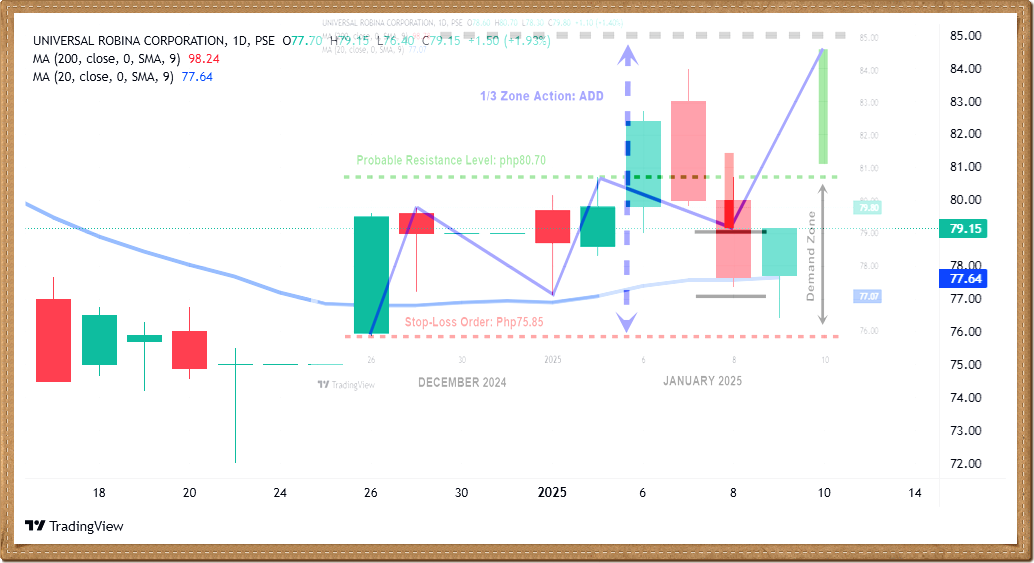
Daily chart for URC as of January 9, 2025, illustrating the price action with an open of Php77.70, a high of Php79.15, a low of Php76.40, and a close of Php79.15.

URC daily chart ending January 9, 2025, showing price recovery from demand zone after testing a low of Php76.40 and closing at Php79.15.

Week 2 scenario for URC prepared on January 5, 2025, depicting the demand zone at Php77.07, resistance level at Php80.70, stop-loss at Php75.85, and a possible price breakout above resistance toward Php85.

Week 2 scenario prepared on January 5, 2025, projecting demand zone support around Php77.07, resistance at Php80.70, and a potential breakout above resistance.

Overlay chart comparing the actual price action of URC for January 6–9, 2025, against the projected Week 2 scenario, showing demand zone validation and resistance at Php80.70.

Overlay of actual URC price action for January 6–9, 2025, with the Week 2 scenario, highlighting how price movements respected the demand zone and resistance levels.

Summary of Week 2 Trading Activity (January 6–9, 2025)

Day 1: January 6, 2025

  • Opening Price: Php79.80

  • High: Php82.70

  • Low: Php79.00

  • Closing Price: Php82.40 (+3.26% from open)

The price made a strong upward move, testing a high of Php82.70, temporarily breaching our projected resistance at Php80.70, before closing near the top of the range. This signaled early bullish momentum, though the breakout was not sustained.

Day 2: January 7, 2025

  • Opening Price: Php83.00

  • High: Php83.95

  • Low: Php79.80

  • Closing Price: Php80.00 (-2.91% from open)

After opening higher and making a new weekly high at Php83.95, the price reversed sharply, closing below the resistance level at Php80.00. This reversal indicated that sellers were active near the highs, resulting in a bearish close.

Day 3: January 8, 2025

  • Opening Price: Php80.00

  • High: Php80.70

  • Low: Php77.35

  • Closing Price: Php77.65 (-2.94% from open)

The price attempted to break above Php80.70 but faced rejection. This led to a sharp sell-off, with the price testing the demand zone near Php77.07 before closing near the day's low. The day’s price action reflected strong selling pressure.

Day 4: January 9, 2025

  • Opening Price: Php77.70

  • High: Php79.15

  • Low: Php76.40

  • Closing Price: Php79.15 (+1.93% from open)

The price opened near the demand zone and tested a low of Php76.40, which remained above our stop-loss level of Php75.85. A recovery followed, with the price closing higher at Php79.15, confirming that buyers stepped in near support.

Assessment of Week 2 Scenario Modeling Skills

  1. Demand Zone Accuracy:
    Our scenario correctly identified the demand zone around Php77.07, which was tested on multiple days. The price consistently found support above this level, confirming it as a key area where buyers are active.

    • Accuracy Rating: High

  2. Resistance Level Testing:
    The projected resistance level at Php80.70 was tested multiple times but not breached on a sustained basis. While a breakout was anticipated, it has not yet occurred, highlighting the importance of this level.

    • Accuracy Rating: Moderate to High

  3. Stop-Loss Placement:
    The stop-loss at Php75.85 was well-placed, allowing room for market fluctuations while protecting against major downside risk. The price remained above this level throughout the week, keeping the position intact.

    • Accuracy Rating: High

  4. Breakout Timing:
    Our expectation of a breakout above Php80.70 early in the week was premature. While the resistance level was correctly identified, the timing of the breakout did not align with our forecast.

    • Accuracy Rating: Moderate

Expectations for Day 5 (January 10, 2025)

  1. Key Levels to Watch:

    • Support: The demand zone around Php77.07 remains crucial. Continued buying interest near this level could provide a foundation for an upward move.

    • Resistance: The resistance at Php80.70 is still a significant barrier. A close above this level with strong volume would indicate a breakout and renewed bullish momentum.

  2. Scenarios to Anticipate:

    • Bullish Scenario: If buying pressure continues and the price breaks above Php80.70, we may see a rally toward the next resistance at Php85.00. This would align with our initial scenario.

    • Neutral Scenario: The price could consolidate between Php77.00 and Php80.70, reflecting ongoing indecision in the market.

    • Bearish Scenario: If the price breaks below the demand zone and breaches the stop-loss at Php75.85, it would invalidate the bullish outlook and signal an exit from the position.

  3. Action Plan:

    • Hold the current position as long as the price remains above the stop-loss level.

    • Monitor for a breakout above Php80.70. If confirmed, consider adding to the position in line with the original 1/3 Zone Action strategy.

    • Exit the position if the price breaches the stop-loss at Php75.85.

Conclusion

With four trading days completed, our Week 2 scenario modeling has proven effective in identifying key technical levels, particularly the demand zone and stop-loss level. While the anticipated breakout has not yet occurred, the price behavior has closely followed our expectations in terms of consolidation and respect for key levels. As we head into the final trading day of Week 2, disciplined monitoring of support and resistance will be crucial.

We will continue to hold the position, awaiting a potential breakout or further confirmation of market direction. Stay tuned for our next update as we conclude Week 2 of trading!


Thank you for following our trading journey. As always, we at Micro Stock Trader are committed to sharing our insights and documenting our progress as we refine our strategies.

Disclaimer: This post is for informational purposes only and should not be considered financial advice. Always do your own research before making any trading decisions.


Related Readings

Micro Stock Trader Portfolio Tracker Page

Micro Stock Trader: Revealed: Our Top 3 Shariah-Compliant Stocks for a Winning Portfolio
Micro Stock Trader: Investing in Semirara Mining and Power Corporation (SCC): What the Technical Indicators Are Telling Us

Micro Stock Trader: Investing in Monde Nissin Corporation (MONDE): What the Technical Indicators Are Telling Us

Micro Stock Trader: Investing in Premiere Island Power REIT Corporation (PREIT): What the Technical Indicators Are Telling Us

Micro Stock Trader: Investing in Asian Terminals Inc. (ATI): What the Technical Indicators Are Telling Us

GAWLOO: Ang Lugawang May Sarap ng Southeast Asia — Gawa ng Batangueñong Galing Abroad

Kung taga-Rosario, Batangas ka at nag-crave ka ng lugaw na may level-up na twist—eto na ang sagot sa panalangin ng sikmura mo: GAWLOO, The Southeast Asian Congee Experience.

Kung taga-Rosario, Batangas ka at nag-crave ka ng lugaw na may level-up na twist—eto na ang sagot sa panalangin ng sikmura mo: GAWLOO, The Southeast Asian Congee Experience.

GAWLOO, The Southeast Asian Congee Experience facade

📍 Matatagpuan sa V. Escaño St., Brgy. C, Rosario Batangas, si GAWLOO ay hindi lang basta kainan — isa siyang kwento ng pangarap, passion, at panlasang umikot sa Asia.


GAWLOO, The Southeast Asian Congee Experience Dine-In

Ang may-ari, si Jay Ubana, ay isang Batangueñong cook na nagtrabaho sa Singapore at Dubai ng 12 taon. Sa dami ng napuntahan niyang bansa—Hong Kong, Taiwan, Singapore—natutunan niyang i-appreciate ang iba't ibang bersyon ng congee. “Paborito talaga ng mga Pinoy ang lugaw,” wika ni Jay, “Kahit anong oras, kahit anong pakiramdam—masarap maglugaw.”

⭐ Lasa't Alaala sa Bawat Higop

Hindi lang basta lugaw, kundi southeast Asian-inspired congee na may toppings na mala-ulam sa sarap:

Kung taga-Rosario, Batangas ka at nag-crave ka ng lugaw na may level-up na twist—eto na ang sagot sa panalangin ng sikmura mo: GAWLOO, The Southeast Asian Congee Experience.

GAWLOO, The Southeast Asian Congee Experience facade

🍲 Seafood Gawloo at Lechon Gawloo — ang kanilang best-sellers na puwedeng pang-breakfast o pang-dinner.

🍛 Mix & Match Toppings: Tuwalya, Chicharon Bulaklak, Atay, Chicken, Fried Tokwa at iba pa.

🍗 Rice Meals tulad ng Chao Fan with Pork Siomai, Chicharon Bulaklak, o Lechon Kawali — swak sa mga ayaw ng sabaw pero gusto pa rin ng siksik sa lasa.

🧋 Drinks? May Black Gulaman at Lychee para pampawi ng uhaw habang humihigop ka ng mainit-init na lugaw.

💸 Presyo na Kayang-Kaya

Hindi mo kailangang bumyahe pa sa abroad para matikman ang ganitong congee—₱80 lang ang Small Bowl na may 1 Topping, at kung mas gutom ka, may Large Bowl for ₱90. Pwede ka ring magpa-top up ng 2, 3 o 4 na toppings para sa ultimate lugaw overload!

🤳 Para sa mga G na umorder online

Pwede kang magpa-deliver! Text o tawag lang sa 09397785658. Hanapin lang ang GAWLOO sa Facebook para sa menu at updates.


Sa totoo lang, sa bawat higop ng lugaw sa GAWLOO, parang may yumayakap sa’yo—maalala mo si Nanay o si Lola na nagluluto ng lugaw tuwing masama ang pakiramdam mo. Ngayon, kahit wala si Nanay sa tabi mo, may GAWLOO ka sa Rosario.

Supportahan natin ang lokal! Tikman ang lugaw na may kwento. Tikman ang GAWLOO.

Featured Post

Micro Harvesting and the Meaning of Money: Why This System Is Mainly a Machine for Making More Money

Home  ›  Micro Harvesting › Micro Harvesting › Philosophy of Money › Micro Harvesting and the Meaning of Money  Hindi lahat ng financial go...